The intersection of festive food styling and child-inclusive kitchen activities provides an exceptional opportunity to enhance holiday gatherings. Traditional celebratory spreads often skew heavily toward dense, carbohydrate-rich pastries and refined sugar confections. While culturally nostalgic, these selections can lead to early-onset fatigue and blood glucose fluctuations during long holiday events.
This master guide provides a comprehensive breakdown for constructing a premium, allergen-friendly Fruit Turkey Platter. By leveraging a spectrum of vibrant, whole fresh fruits organized systematically on wooden skewers, this assembly functions as both a visually striking centerpiece and a refreshing, nutrient-dense appetizer. Designed to appeal equally to toddlers and adults, it serves as an elegant palate cleanser that bridges generations at any Thanksgiving feast.
Section 1: The Essential Structural and Fruit Blueprint
Achieving a stable, uniform, and visually balanced fruit turkey requires precise raw material selection. The choice of specific fruits ensures structural integrity on the skewers while maintaining a flawless, vibrant presentation.
Hardware and Base Architecture
- 18 Standard Wooden Skewers: The primary canvas for building out the main “turkey feather” perimeter.
- 6 Heavy-Duty Toothpicks: Used for crafting smaller, compact mini-skewers to fill in low-profile gaps near the base.
- 1/2 Fresh Pear: Sliced cleanly down the center lengthwise to serve as the stationary, low-profile anchor representing the turkey’s main body.
- 2 Pieces Candy Eyes: Small decorative accents applied to the upper narrow neck of the pear to instantly define the turkey’s facial structure.
The Colorful Feather Palette
- 9 Large Fresh Strawberries: Halved precisely to yield 18 vibrant, conical red tips that define the outermost edge of the feather perimeter.
- 18 Sweet Mandarin Orange Slices: Seedless, pre-peeled citrus segments that introduce bright orange tones and a juicy texture.
- 24 Uniform Cantaloupe Chunks: Divided intentionally between the multi-colored skewers and raw structural cuts used to carve out the turkey’s signature beak and bottom legs.
- 18 Fresh Pineapple Chunks: Firm, golden-yellow cubes that provide a stable center point on the skewer line without slipping.
- 18 Whole Green Grapes: Crisp, structural spheres that comfortably grip the wooden fibers, keeping neighboring ingredients locked in position.
- 18 Fresh Honeydew Melons Chunks: Cool, soft pastel-green segments that complete the inner layers of the colorful plumage.
- 30 Whole Plump Blueberries: Tiny, deep-indigo accents utilized across the low-profile toothpicks to add rich color contrast near the base of the platter.
Section 2: Step-by-Step Structural Assembly Instructions
Building a stable fruit turkey depends entirely on an efficient workspace and uniform ingredient patterns. Follow these sequential execution phases to build your platter:
Phase 1: Precision Prep and Optimization
Thoroughly wash all selected fruits under cold water and pat them completely dry using fresh paper towels. Excess surface moisture will cause the skewers to slip and can compromise the integrity of the fruit during storage. Peel your cantaloupe, honeydew, and fresh pineapple, cutting them into uniform, bite-sized cubes. Gently peel the mandarin oranges, separating them into individual segments.
Phase 2: Skewer Engineering and Assembly Lines
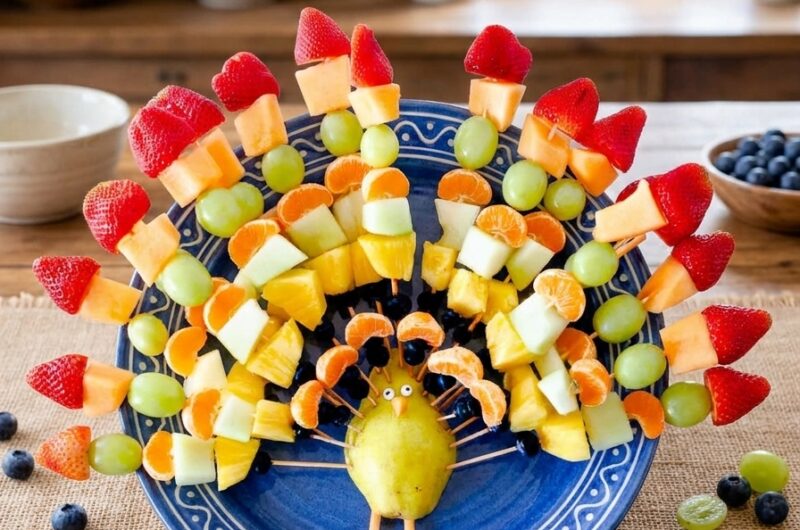
To streamline the process, organize your fruit chunks into separate bowls to create an efficient assembly line. Take your first wooden skewer and thread the fruit in a distinct, uniform color sequence. Start with the dense honeydew at the base, followed by a green grape, a pineapple chunk, a cantaloupe cube, and a mandarin segment, finishing with a halved strawberry at the pointed tip. Repeat this exact sequence across all 18 large wooden skewers to ensure a clean, symmetrical layout. Next, thread your smaller blueberries and remaining citrus onto the 6 short toothpicks to create your accent mini-skewers.
Phase 3: Platter Layout and Body Anchoring
Select a wide, flat serving platter or a clean wooden charcuterie board. Slice a fresh pear cleanly in half lengthwise and place one half face-down in the lower center of the board to establish the turkey’s main body. Carefully arrange the 18 main fruit skewers in a wide, sweeping semi-circle fanning out from the curved edges of the pear. Gently tuck the pointed ends slightly beneath or flush against the pear body to mimic an authentic, layered feather pattern. Scatter the 6 smaller blueberry toothpicks into any open gaps around the bottom base to hide the raw skewer ends.
Phase 4: Detailed Facial Artistry
Cut a small, sharp triangle out of a leftover cantaloupe slice to form the turkey’s beak, and carve two simple, elongated strips to serve as the feet. Place the cantaloupe feet flat on the platter extending from the bottom of the pear. To secure the face without relying on plastic picks, apply a tiny drop of sticky, raw honey to the back of the candy eyes and the cantaloupe beak, pressing them firmly onto the upper neck of the pear body. Let it rest undisturbed for 5 minutes to set before moving the platter.
Section 3: Professional Styling and Kitchen Production Secrets
- The Enzymatic Browning Mitigation Rule: Pears and apples naturally oxidize and turn an unappealing brown when exposed to open air. To keep your turkey body looking crisp and pristine throughout a long holiday event, submerge the halved pear in a quick bath of 1 cup cold water mixed with 1 tablespoon of fresh lemon juice for 60 seconds before assembling. The ascorbic acid completely halts browning without altering the fruit’s flavor.
- The Strategic Base Layer Protocol: When selecting a presentation surface, always opt for completely flat platters rather than lipped or concave bowls. A curved base forces the outer fruit skewers to tilt upward or roll sideways, disrupting the clean feather pattern. If your platter surface feels slick, place a thin sheet of parchment paper down first to keep the wooden skewers firmly in place.
- The Make-Ahead Production Workflow: If you are managing a busy holiday schedule, you can easily assemble the components 24 hours in advance. Prepare all 18 multi-colored skewers the night before and lay them flat inside an airtight container lined with dry paper towels to catch any dripping juice. Store the carved pear body separately in a zip-top bag with a splash of lemon juice. Assemble the components on your platter just before your guests arrive for a fast, fresh presentation.
Section 4: Creative Holiday Variations and Themes
The Autumn Rainbow Cheese Board
For a more filling appetizer, transform the platter into a sweet and savory experience. Swap out the honeydew and cantaloupe cubes on alternating skewers for bite-sized cubes of sharp white cheddar, gouda, or Colby Jack cheese. This pairing balances the fresh sweetness of the fruit with a rich, satisfying protein element.
The Allergy-Conscious Seed Alternative
If your gathering requires a strict nut-free and seed-friendly environment, this fruit-only platter naturally fits the bill. To elevate the presentation with extra crunch, scatter raw sunflower seeds or pumpkin seeds around the base of the platter to create a rustic, autumn-inspired “forest floor” aesthetic.
The Festive Thanksgiving Dip Accolade
Accompany your fruit platter with a dedicated dipping station to elevate the serving experience. A simple honey-vanilla Greek yogurt dip or a plant-based coconut cream dip pairs beautifully with the fresh skewers, offering a rich, creamy contrast to the crisp fruit textures.
Section 5: Long-Term Storage and Leftover Utilization
- Standard Refrigerator Storage Guidelines: If you have leftover skewers after your event, carefully remove the fruit from the wooden sticks and separate any soft berries from the firm melons. Store the pieces in separate airtight containers lined with a fresh paper towel to absorb extra moisture. Enjoy within 3 days for peak freshness.
- The Waste-Free Morning Smoothie Strategy: Never let leftover holiday fruit go to waste. Toss any remaining melon cubes, grapes, and berries directly into a freezer-safe bag and freeze them solid. In the morning, blend these frozen pieces with a splash of almond milk and a scoop of your favorite protein powder for a refreshing, post-holiday breakfast smoothie.
Section 6: Estimated Nutritional Profile
The values listed below are calculated approximations per individual serving based on dividing the completed master fruit platter into 18 identical side-portions:
- Calories: 39 kcal
- Carbohydrates: 9 g
- Protein: 0.5 g
- Fat: 0.2 g
- Saturated Fat: 0.01 g
- Polyunsaturated Fat: 0.02 g
- Monounsaturated Fat: 0.01 g
- Sodium: 0.2 mg
- Potassium: 26 mg
- Dietary Fiber: 1 g
- Sugars: 2 g
- Vitamin A: 6 IU
- Vitamin C: 4 mg
- Calcium: 2 mg
- Iron: 0.1 mg
Please Note: I am not a doctor, certified nutritionist, or medical professional. The nutritional information and dietary suggestions provided in this article are based purely on raw ingredient calculations and are intended for general educational and informational purposes only. Every individual’s health conditions, allergies, and dietary needs are completely different. Please consult with a qualified doctor or healthcare professional before making significant dietary changes.