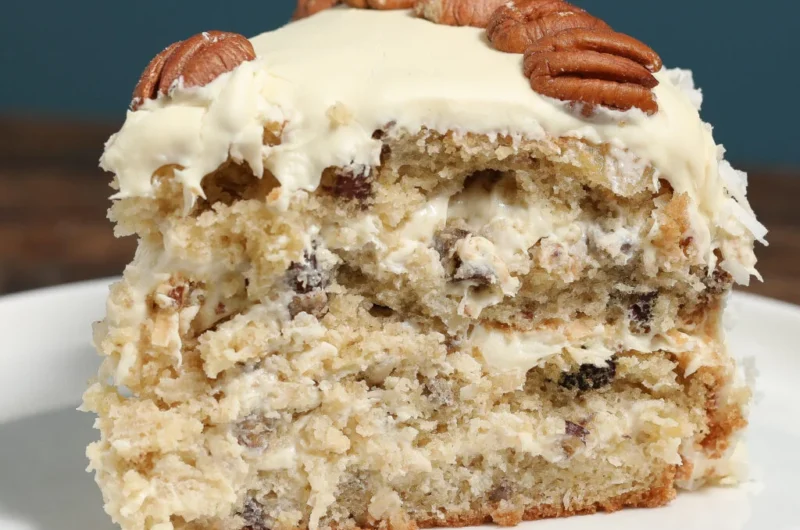
This Italian cream cake builds its signature moist, tender crumb through a combination of butter and oil, buttermilk, and separately whipped egg whites folded in at the end. Sweetened coconut and chopped pecans mixed directly into the batter give the cake its characteristic texture and flavor, while a rich cream cheese frosting, decorated with ground pecans, pecan halves, and wafer cookies, finishes the layered cake with an elegant, textured presentation.
What makes this cake technically interesting is the separation of eggs into yolks and whites, handled differently throughout the process. The yolks are incorporated early into the butter mixture for richness, while the whites are whipped separately to stiff peaks and folded in near the end, which is what gives the finished cake its light, fluffy texture despite its rich ingredient list. Careful attention to technique at each stage — from alternating dry and wet ingredients to properly folding in egg whites to applying a crumb coat before final frosting — is what separates a good version of this cake from a great one.
Below is a full breakdown of the workflow, ingredient roles, and technique for both the cake and frosting, along with the assembly and decoration steps that bring the whole dessert together.
Kitchen Workflow: How the Process Is Organized
This recipe breaks into three major stages: preparing the cake batter, making the cream cheese frosting, and assembling and decorating the finished cake.
Stage 1 — Prepare the Cake Batter. The oven is preheated to 350°F, and three 8-inch cake pans are greased and floured. Butter, oil, and sugar are beaten together until light and fluffy, then egg yolks are incorporated one at a time, beating well after each addition. In a separate bowl, flour and baking soda are whisked together, then gradually added to the butter mixture, alternating with buttermilk, beginning and ending with the dry ingredients. This alternating method prevents the batter from curdling or becoming overly dense, since adding all the flour or all the liquid at once can disrupt the emulsion built up in the earlier creaming step. Vanilla extract, coconut, and pecans are stirred in next. Separately, egg whites are beaten until stiff peaks form, then gently folded into the batter to maintain its light texture — folding, rather than stirring vigorously, is what preserves the air whipped into the egg whites, which is essential for the cake’s final texture. The batter is divided evenly among the prepared pans and baked for 25–30 minutes, until golden brown and a toothpick inserted in the center comes out clean, then cooled completely on wire racks.
Stage 2 — Make the Cream Cheese Frosting. Cream cheese and butter are beaten together until smooth and creamy. Confectioners’ sugar is added gradually in two batches, beating until fully incorporated each time — adding it in stages rather than all at once helps prevent a sugar cloud and ensures even mixing. Vanilla extract is stirred in, and the frosting is beaten until smooth and fluffy. It’s covered with a damp towel while the cake layers finish cooling, which prevents the frosting from drying out or forming a crust on its surface before it’s used.
Stage 3 — Assemble and Decorate. One cooled cake layer is placed on a serving plate, and a thin layer of frosting is spread on top. This process is repeated with the second and third layers, with frosting spread between each. A thin crumb coat is applied over the entire cake to trap loose crumbs, and the cake is refrigerated for 15 minutes to let this coat set. The remaining frosting is then applied as the final coat, smoothed with a bench scraper. Ground pecans are pressed onto the bottom edges of the cake, frosting swirls are piped around the top edge, and the swirls are finished with a sprinkle of ground pecans, pecan halves placed between swirls, and wafer cookies on top.
Component Breakdown
It’s useful to think of this recipe in terms of five functional components.
1. The Moisture and Richness — Butter, Oil, and Buttermilk Butter contributes flavor, while oil helps keep the cake moist even after baking and cooling — a combination that balances richness with a tender crumb. Buttermilk adds tanginess and further tenderness to the finished cake.
2. The Structure — Flour, Baking Soda, and Eggs All-purpose flour provides the base structure of the cake, while baking soda acts as the leavening agent responsible for rise. Eggs, split into yolks and whites, serve two different roles: the yolks add richness early in the mixing process, while the whipped whites folded in later create a lighter, airier texture.
3. The Texture and Flavor Mix-Ins — Coconut and Pecans Sweetened flake coconut adds both texture and sweetness directly into the batter, while chopped pecans contribute crunch and a nutty flavor that’s central to what makes this cake distinctly “Italian cream” style rather than a standard vanilla or butter cake.
4. The Frosting Base — Cream Cheese and Butter This combination forms the smooth, rich foundation of the frosting, providing both tang from the cream cheese and richness from the butter.
5. The Decoration — Ground Pecans, Pecan Halves, and Wafer Cookies These elements aren’t just decorative — ground pecans pressed onto the sides echo the pecans baked into the cake itself, while pecan halves and wafer cookies add textural contrast and visual polish to the finished presentation.
Step-by-Step Assembly Strategy
To build a properly textured cake with a polished finish, follow this sequence:
- Preheat the oven to 350°F. Grease and flour three 8-inch cake pans, or coat them with a flour-based baking spray.
- Beat the butter, oil, and sugar together in a large mixing bowl until light and fluffy.
- Add the egg yolks one at a time, beating well after each addition.
- Whisk together the flour and baking soda in a separate bowl. Gradually add this to the butter mixture, alternating with the buttermilk, beginning and ending with the dry ingredients.
- Stir in the vanilla extract, coconut, and pecans.
- Beat the egg whites in a separate bowl until stiff peaks form. Gently fold them into the batter to preserve the light texture.
- Divide the batter evenly among the prepared pans. Bake for 25–30 minutes, until golden brown and a toothpick inserted in the center comes out clean. Let the cakes cool completely on wire racks before frosting.
- For the frosting, beat the cream cheese and butter together until smooth and creamy.
- Add the confectioners’ sugar gradually in two batches, beating until fully incorporated each time. Stir in the vanilla extract and beat until the frosting is smooth and fluffy.
- Place one cake layer on a serving plate or cake stand. Spread a thin layer of frosting on top.
- Repeat with the second and third layers, spreading frosting between each.
- Apply a thin crumb coat over the entire cake to trap loose crumbs. Refrigerate for 15 minutes to let it set.
- Cover the cake with the remaining frosting, smoothing the top and sides with a bench scraper.
- Press ground pecans onto the bottom edges of the cake. Pipe swirls of frosting around the top edge using a piping bag fitted with a large closed star tip.
- Sprinkle the swirls with ground pecans, place pecan halves between each swirl, and top with wafer cookies for the final decorative touch.
- Refrigerate the assembled cake, and bring it to room temperature before serving for the best flavor and texture.
Tips for Success
- Use room temperature ingredients. This ensures all components mix together smoothly and evenly.
- Beat the egg whites properly. Whipping to stiff peaks is what gives the cake its light, airy texture once folded in.
- Don’t skip the crumb coat. This thin initial layer locks in crumbs, resulting in a cleaner, more polished final frosting layer.
- Chill before serving, but bring to room temperature first. This combination helps the cake set properly while still delivering the best flavor and texture when eaten.
Part 2: Recipe Card
Italian Cream Cake
Description: A rich, moist layer cake made with buttermilk, coconut, and pecans, finished with a smooth cream cheese frosting and decorated with ground pecans, pecan halves, and wafer cookies.
Duration:
- Prep Time: 20 minutes
- Cook Time: 25 minutes
- Total Time: 45 minutes
- Servings: 10
Equipment:
- Three 8-inch cake pans
- Electric mixer
- Piping bag with a large closed star tip
- Bench scraper or cake smoother
- Cooling racks
Ingredients:
Cake
- 1/2 cup unsalted butter, room temperature
- 1/2 cup vegetable oil
- 2 cups granulated sugar
- 5 large eggs, yolks and whites separated
- 2 cups all-purpose flour
- 1 tsp baking soda
- 1 cup buttermilk
- 1 tsp vanilla extract
- 1 cup sweetened flake coconut
- 1 cup chopped pecans
Frosting and Decoration
- 16 oz cream cheese, room temperature
- 1/2 cup unsalted butter, room temperature
- 8 cups confectioners’ sugar
- 2 tsp vanilla extract
- 1/3 cup ground pecans
- 8 pecan halves
- 8 rolled wafer cookies (such as Pirouettes)
Instructions:
- Preheat the oven to 350°F. Grease and flour three 8-inch cake pans.
- Beat the butter, oil, and sugar until fluffy. Add the egg yolks one at a time, beating after each addition.
- Whisk together the flour and baking soda. Add to the butter mixture alternately with the buttermilk. Stir in the vanilla, coconut, and pecans.
- Beat the egg whites to stiff peaks. Fold into the batter. Divide the batter among the pans.
- Bake for 25–30 minutes. Cool completely on wire racks.
- For the frosting, beat the cream cheese and butter until smooth. Gradually add the sugar and vanilla. Beat until fluffy.
- Assemble the layers, spreading frosting between each. Apply a crumb coat, chill, then frost fully.
- Decorate with ground pecans, frosting swirls, pecan halves, and wafer cookies. Refrigerate and bring to room temperature before serving.
Notes:
- Use room temperature ingredients throughout for the smoothest mixing.
- Fold, rather than stir, the whipped egg whites into the batter to preserve the cake’s light texture.
- Don’t skip the crumb coat step — it locks in crumbs for a cleaner final finish.
- Nutrition (per serving, approximate): Calories: 1216 kcal, Carbohydrates: 149g, Protein: 11g, Fat: 68g, Saturated Fat: 38g, Trans Fat: 1g, Cholesterol: 201mg, Sodium: 505mg, Potassium: 315mg, Fiber: 6g, Sugar: 123g, Vitamin A: 1101IU, Vitamin C: 1mg, Calcium: 79mg, Iron: 2mg.
Medical and Nutritional Disclaimer
The information provided in this recipe and guide is intended for general informational and educational purposes only and does not constitute medical, dietary, or nutritional advice. Nutritional values listed are automatically calculated estimates and should be used as an approximation only; actual values may vary based on specific ingredient brands, substitutions, and portion sizes used. This recipe is not intended to diagnose, treat, cure, or prevent any disease or health condition. Individuals with food allergies, dietary restrictions, or specific medical conditions should consult with a qualified healthcare provider or registered dietitian before making dietary changes or preparing this recipe. The author and publisher assume no responsibility for any adverse effects resulting from the use or application of the information contained herein.