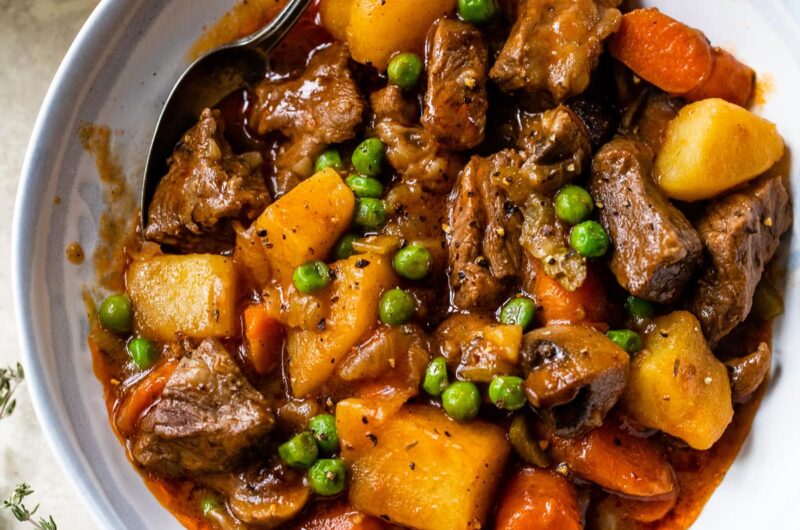
This hearty beef stew builds deep flavor through classic braising technique: chuck roast is browned in batches, red wine deglazes the pot to capture every bit of caramelized flavor left behind, and the meat simmers low and slow in a tomato-based broth until it becomes fork-tender. Fresh herbs like oregano, thyme, and basil, along with cremini mushrooms and carrots, give the stew its Italian-inspired character, while a one-pot method keeps the process straightforward despite its layered flavor.
What makes this stew work so well is the sequence of building flavor in stages before everything comes together to simmer. Sautéing the onion and carrot first, then browning the beef separately, then deglazing with wine — each of these steps develops flavor that would be lost if everything were simply dumped into the pot at once and simmered. The long, mostly hands-off simmering time at the end is what finally breaks down the chuck roast’s connective tissue into the tender, satisfying texture a good beef stew should have.
Below is a full breakdown of the workflow, ingredient roles, and technique for building a properly layered, tender stew.
Kitchen Workflow: How the Process Is Organized
This recipe breaks into three stages: sautéing the aromatics and browning the beef, deglazing and building the braising liquid, and simmering to tenderness.
Stage 1 — Sauté the Aromatics and Brown the Beef. A Dutch oven is heated over medium-high heat, and 1 teaspoon of oil is added. Chopped onion and chopped carrot are sautéed for 8 minutes, stirring occasionally, followed by minced garlic, sautéed for 45 seconds while stirring constantly. This mixture is removed from the pan. More oil is then added, and the beef — seasoned with salt and pepper and dredged in flour — is browned in two batches, about 6 minutes each, until browned on all sides, then removed from the pan. Browning the beef in batches, rather than all at once, is important: overcrowding the pan would cause the meat to steam rather than develop a proper sear, missing out on the deep flavor that browning provides.
Stage 2 — Deglaze and Build the Braising Liquid. Red wine is added to the now-empty pan and brought to a boil, scraping up the browned bits stuck to the bottom of the pot as it cooks. The wine reduces down to about 1/3 cup, which takes about 5 minutes. This deglazing step captures all the caramelized flavor left behind from browning the beef and sautéing the vegetables, folding it directly into the stew’s liquid base rather than letting it go to waste. The meat and onion mixture are returned to the pan, along with the tomatoes, broth, water, oregano, thyme, bay leaf, and mushrooms, and everything is brought to a boil.
Stage 3 — Simmer to Tenderness. The pot is covered, the heat is reduced, and the stew simmers for 45 minutes, stirring occasionally. It’s then uncovered, sliced carrots are stirred in, and the stew continues simmering uncovered for 1 hour, or until the meat is very tender, stirring occasionally throughout. This extended simmering time is what allows the tough connective tissue in the chuck roast to fully break down. Once tender, the bay leaf is discarded, and the remaining salt, basil, and parsley are stirred in at the very end, preserving their fresh flavor rather than cooking them down over the long simmer.
Component Breakdown
It’s useful to think of this recipe in terms of five functional components.
1. The Protein — Boneless Chuck Roast Chuck roast, trimmed and cut into cubes, is chosen for its connective tissue, which breaks down over the long simmer into exceptional tenderness — a leaner cut wouldn’t achieve the same result with this cooking method.
2. The Aromatic Base — Onion, Carrot, and Garlic Sautéed onion and carrot form the foundational vegetable flavor of the stew, while garlic, added briefly at the end of this stage, contributes fragrance without the risk of burning that comes from cooking it too long.
3. The Braising Liquid — Red Wine, Tomatoes, Beef Broth, and Water Red wine, reduced after deglazing the pot, adds depth and acidity. Chopped, seeded, peeled plum tomatoes provide the tomato-based backbone typical of Italian-style stews, while beef broth and water round out the braising liquid to the right consistency.
4. The Herbs and Vegetables — Oregano, Thyme, Bay Leaf, Mushrooms, and Sliced Carrot Fresh oregano and thyme, along with a bay leaf, infuse the stew with herbal depth throughout the long simmer. Cremini mushrooms add an earthy note, and additional sliced carrot, added partway through cooking rather than at the very start, contributes texture and sweetness without becoming overly soft.
5. The Fresh Finish — Basil and Parsley Chopped fresh basil and parsley are stirred in at the very end, after the long simmer is complete, which preserves their bright, fresh flavor rather than letting it cook away over the extended cooking time.
Step-by-Step Assembly Strategy
To build a properly layered, tender stew, follow this sequence:
- Heat a Dutch oven over medium-high heat. Add 1 teaspoon of oil. Add the chopped onion and chopped carrot, sautéing for 8 minutes, stirring occasionally.
- Add the minced garlic and sauté for 45 seconds, stirring constantly to avoid burning. Remove the vegetable mixture from the pan.
- Add 1 tablespoon of oil to the pan. Place the flour in a shallow dish. Sprinkle the beef with salt and pepper, then dredge it in the flour.
- Add half of the beef to the pan and sauté for 6 minutes, browning on all sides. Remove from the pan and repeat with the remaining beef.
- Add the red wine to the pan and bring to a boil, scraping up any browned bits from the bottom. Cook until the wine reduces to about 1/3 cup, about 5 minutes.
- Return the meat and the onion mixture to the pan. Add the tomato, broth, water, oregano, thyme, bay leaf, and mushrooms, and bring to a boil.
- Cover, reduce the heat, and simmer for 45 minutes, stirring occasionally.
- Uncover and stir in the sliced carrot. Continue simmering uncovered for 1 hour, or until the meat is very tender, stirring occasionally.
- Discard the bay leaf. Stir in the remaining salt, basil, and parsley.
- Serve hot, ladled into bowls.
Part 2: Recipe Card
Italian-Inspired Beef Stew
Description: A hearty, one-dish Italian-inspired beef stew with tender chuck roast, tomatoes, cremini mushrooms, and carrots, finished with fresh basil and parsley.
Duration:
- Total Time: 2 hours 40 minutes
- Yield: 8 servings (serving size: 1 cup)
Ingredients:
- 7 tsp olive oil, divided
- 1 1/2 cups chopped onion
- 1/2 cup chopped carrot
- 1 tbsp minced garlic
- 1/4 cup all-purpose flour
- 2 lbs boneless chuck roast, trimmed and cut into cubes
- 3/4 tsp salt, divided
- 1/2 tsp black pepper
- 1 cup dry red wine
- 3 3/4 cups chopped, seeded, peeled plum tomato (about 2 lbs)
- 1 1/2 cups fat-free, lower-sodium beef broth
- 1/2 cup water
- 2 tsp chopped fresh oregano
- 2 tsp chopped fresh thyme
- 1 bay leaf
- 1 (8-oz) package cremini mushrooms, quartered
- 3/4 cup (1/4-inch-thick) slices carrot
- 2 tbsp chopped fresh basil
- Chopped fresh parsley, to finish
Instructions:
- Heat a Dutch oven over medium-high heat. Add 1 teaspoon oil to the pan. Add the onion and chopped carrot; sauté 8 minutes, stirring occasionally. Add garlic; sauté for 45 seconds, stirring constantly. Remove from the pan.
- Add 1 tablespoon oil to the pan. Place the flour in a shallow dish. Sprinkle the beef with 1/2 teaspoon salt and the pepper; dredge in flour. Add half of the beef to the pan; sauté 6 minutes, browning on all sides. Remove from the pan. Repeat with remaining beef.
- Add the wine to the pan and bring to a boil, scraping the pan. Cook until reduced to 1/3 cup (about 5 minutes). Return the meat and onion mixture to the pan. Add the tomato, broth, water, oregano, thyme, bay leaf, and mushrooms; bring to a boil. Cover, reduce heat, and simmer for 45 minutes, stirring occasionally. Uncover, and stir in the sliced carrot. Simmer, uncovered, for 1 hour or until the meat is very tender, stirring occasionally. Discard the bay leaf. Stir in the remaining 1/4 teaspoon salt, basil, and parsley.
Notes:
- Brown the beef in batches to avoid overcrowding the pan, which helps develop a proper sear rather than steaming the meat.
- Scraping up the browned bits during the wine reduction step captures extra flavor for the braising liquid.
- Add the sliced carrot partway through cooking, rather than at the start, so it stays tender without becoming overly soft.
- Nutrition (per serving, approximate): Calories: 334, Fat: 13g, Saturated Fat: 3.9g, Monounsaturated Fat: 0.8g, Polyunsaturated Fat: 6.6g, Protein: 40.6g, Carbohydrates: 12.2g, Fiber: 2.4g, Cholesterol: 86mg, Iron: 4.1mg, Sodium: 387mg, Calcium: 51mg.
Medical and Nutritional Disclaimer
The information provided in this recipe and guide is intended for general informational and educational purposes only and does not constitute medical, dietary, or nutritional advice. Nutritional values listed are automatically calculated estimates and should be used as an approximation only; actual values may vary based on specific ingredient brands, substitutions, and portion sizes used. This recipe is not intended to diagnose, treat, cure, or prevent any disease or health condition. Individuals with food allergies, dietary restrictions, or specific medical conditions should consult with a qualified healthcare provider or registered dietitian before making dietary changes or preparing this recipe. The author and publisher assume no responsibility for any adverse effects resulting from the use or application of the information contained herein.