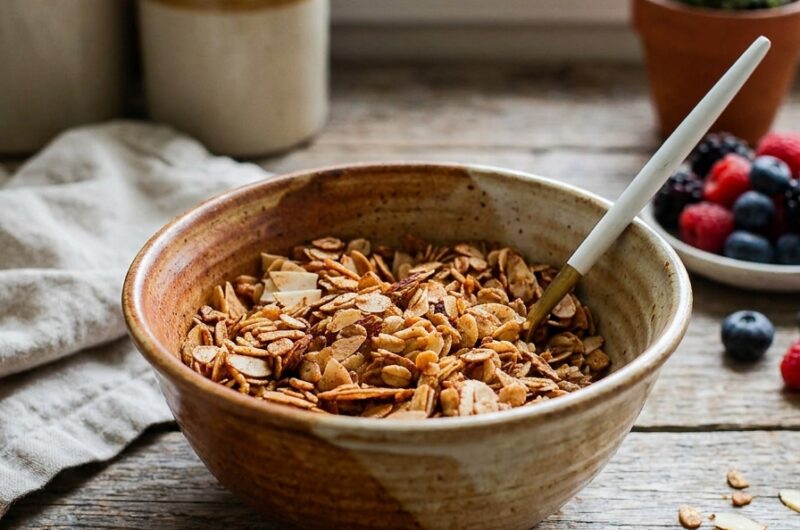
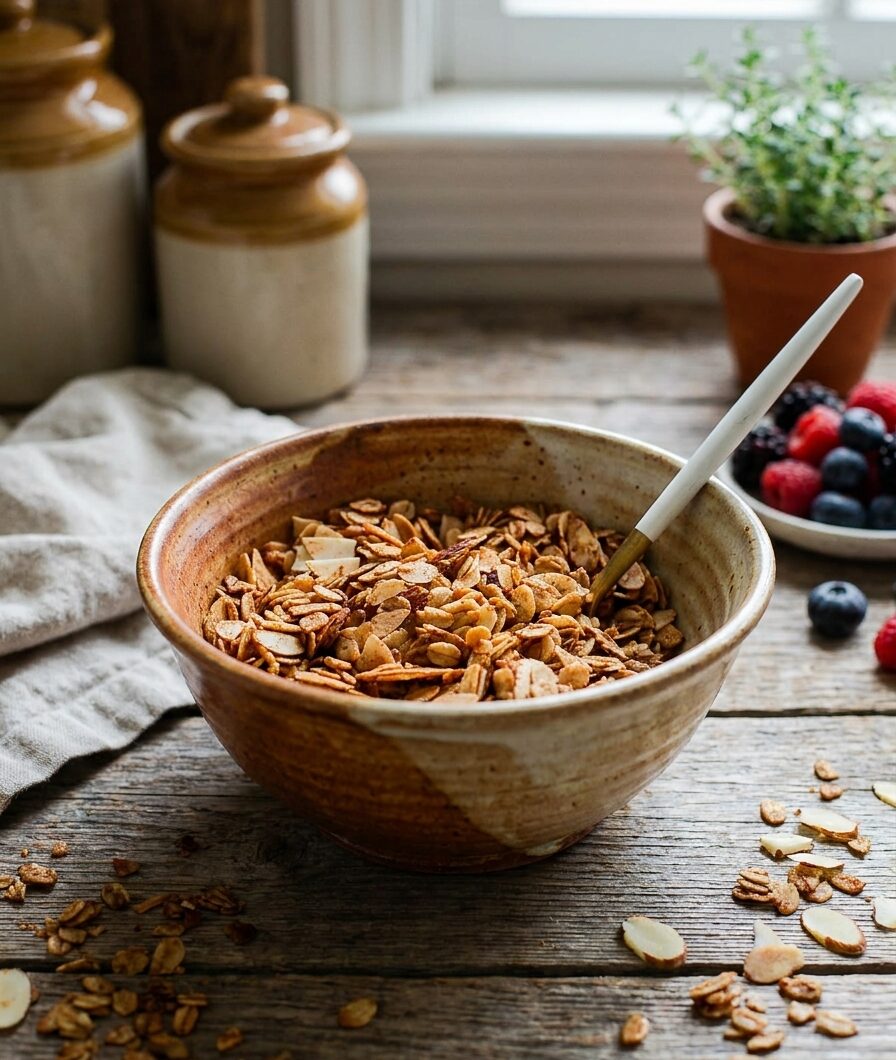
This Almond Maple Olive Oil Granola Recipe is a crisp, lightly sweet homemade breakfast made with gluten-free rolled oats, slivered almonds, extra virgin olive oil, pure maple syrup, cinnamon, vanilla, and maple extract. It offers a simple alternative to heavily sweetened store-bought granola while keeping the familiar toasted oat flavor and satisfying crunch that make granola so useful for breakfast, snacks, and meal prep.
Instead of using butter or coconut oil, this healthy homemade granola relies on extra virgin olive oil to coat the oats and almonds before baking. Maple syrup provides sweetness and helps the mixture brown, while cinnamon, vanilla, and maple extract add warmth and depth. The finished granola is golden, crisp, and nutty without requiring a long ingredient list or complicated preparation.
Why You Prefer This Recipe
Homemade granola gives you greater control over the ingredients and sweetness than many packaged varieties. This particular recipe uses only ⅓ cup maple syrup for 14 servings, resulting in approximately 6 grams of sugar per serving according to the supplied nutritional calculation. The sweetness is balanced by cinnamon, vanilla, maple extract, sea salt, almonds, and the naturally toasted flavor of the oats.
Preparation is also straightforward. There is no stovetop cooking and no complicated technique. The dry ingredients are combined, the liquid ingredients are whisked separately, everything is mixed together, and the granola is baked until golden. Allowing it to cool completely after baking develops the final crisp texture.
What Makes Olive Oil Granola Different?
Most homemade granola recipes need some type of fat to coat the oats and help them toast. This recipe uses ½ cup extra virgin olive oil, giving the granola a lighter, subtly savory and fruity character compared with versions prepared with butter or coconut oil.
Olive oil also combines easily with maple syrup and extracts, creating a liquid mixture that can be distributed throughout the oats and almonds. When baked, this coating encourages even browning and helps produce the crisp texture expected from granola. The flavor is not intended to overpower the recipe; instead, it complements the almonds, maple, cinnamon, and toasted oats.
Why Rolled Oats Work Best
The foundation of the recipe is 4 cups gluten-free rolled oats. Rolled oats maintain their shape well during baking and provide the hearty, chewy-crisp texture associated with traditional granola. Their broad surface also gives the olive oil and maple mixture plenty of area to coat.
The supplied recipe permits quick oats as a variation, although they will create a less chunky texture. Since the standard ingredient list specifically calls for gluten-free rolled oats, those remain the preferred option in the recipe card. If preparing the recipe for someone with celiac disease or strict gluten avoidance, verify that the oats are appropriately certified.
Slivered Almonds Add Plenty of Crunch
Two cups of slivered almonds make this a particularly nutty maple almond granola recipe. The almonds toast alongside the oats and develop additional flavor and crunch in the oven. Their thin shape also allows them to distribute throughout the granola rather than forming large, hard pieces.
The quantity of almonds is generous compared with many granola recipes, making their flavor an important part of the finished result rather than simply a garnish. Each serving contains a mixture of toasted oats and nuts, making the granola satisfying whether eaten as cereal, sprinkled over yogurt, or enjoyed as a snack.
Maple Syrup Provides Natural Sweetness
This granola uses ⅓ cup maple syrup as its primary sweetener. Maple syrup contributes more than sweetness: its characteristic caramel-like flavor works naturally with toasted almonds, cinnamon, vanilla, and olive oil.
During baking, the maple syrup coats the oats and nuts and contributes to their golden finish. Because the recipe is designed as a lower-sugar granola, there is no need to add extra sweetener to the standard formula. Allow the maple flavor to work alongside the cinnamon and extracts rather than expecting the finished granola to taste as sweet as many commercial breakfast cereals.
Cinnamon Adds Warm Flavor
One and a half teaspoons of cinnamon bring warmth to the oat and almond mixture. Cinnamon is particularly effective in a lower-sugar recipe because its aroma creates a naturally sweet impression without requiring additional maple syrup.
The spice should be mixed thoroughly with the oats, almonds, and sea salt before the liquid ingredients are introduced. This helps distribute it evenly through the batch. The supplied variations allow nutmeg, pumpkin pie spice, or cardamom instead, but cinnamon remains the standard ingredient and has therefore been preserved unchanged in the recipe card.
Why Sea Salt Is Important
One teaspoon of sea salt balances the sweetness of the maple syrup and enhances the toasted flavor of the almonds and oats. Although granola is generally thought of as a sweet breakfast food, a small amount of salt prevents the flavor from becoming flat.
Mix the salt evenly through the dry ingredients before adding the olive oil mixture. Because salt crystals vary in size, the source notes that table salt may be substituted only with an appropriate reduction in quantity. For the original recipe, however, use the specified one teaspoon of sea salt.
Vanilla and Maple Extract Build Flavor
The recipe includes 1 teaspoon vanilla extract and ½ teaspoon maple extract. These ingredients add aroma and make the maple character more noticeable without requiring a larger quantity of maple syrup.
Vanilla softens and rounds out the toasted flavors, while maple extract reinforces the maple syrup. The supplied recipe notes that maple extract is optional in variations and can be replaced with butter extract or additional vanilla, but the standard formula includes it. Keeping both extracts gives the finished granola its intended warm maple-vanilla character.
How to Prepare the Granola Mixture
Begin by preheating the oven to 325°F (163°C). Line a large rimmed baking sheet with parchment paper. The supplied recipe also allows a 9 × 13-inch baking dish.
Combine the rolled oats, slivered almonds, cinnamon, and sea salt in a large bowl. In a separate bowl, whisk the extra virgin olive oil, maple syrup, vanilla extract, and maple extract until evenly combined. Preparing the wet mixture separately helps distribute the extracts and syrup through the oil before it reaches the oats.
Coat the Oats and Almonds Evenly
Pour the olive oil and maple mixture over the dry ingredients. Mix thoroughly so the oats and almonds are evenly coated. Take a little time with this step because uneven coating can lead to sections that brown differently in the oven.
The mixture should look lightly glossy and evenly moistened rather than wet. Once coated, transfer it to the parchment-lined baking sheet and spread it into a relatively even layer. An even thickness promotes consistent browning and reduces the chance of thin edges burning before thicker areas become crisp.
How Long to Bake Homemade Granola
Bake the granola at 325°F for 35–40 minutes. Stir the mixture once around halfway through the baking period. The midway stir redistributes the oats and nuts, helping areas that were against the hot baking sheet move to the surface and vice versa.
The granola is ready when it develops an even golden-brown appearance. Oven temperatures vary, so visual appearance matters alongside the timer. If your oven tends to run hot, the supplied notes recommend reducing the baking time by approximately five minutes to help prevent burnt edges.
Why Cooling Granola Is So Important
Freshly baked granola can still feel somewhat soft when it first comes out of the oven. This does not necessarily mean it needs more baking. The mixture becomes noticeably crisper as it cools.
Leave the granola on the baking sheet until it reaches room temperature. Avoid transferring warm granola immediately into a storage container because trapped heat can create condensation. That added moisture can soften the oats and reduce the crunchy texture you worked to create during baking.
How to Make Chunky Granola Clusters
If you prefer chunky homemade granola, the way you handle the mixture near the end of baking and during cooling makes a difference. During the final ten minutes, gently press the granola down using a piece of parchment paper.
After baking, allow it to cool completely without stirring. Once cool, the pressed layer can naturally break into larger pieces. If you stir it repeatedly while it is hot, you are more likely to create loose granola rather than substantial clusters.
How to Make an Even Lower-Sugar Granola
The standard recipe contains ⅓ cup maple syrup, which should be retained when preparing the original version. However, the supplied notes provide a specific lower-sugar variation: reduce the maple syrup to ¼ cup and slightly increase the vanilla or maple extract.
Using the extracts to strengthen the flavor can help compensate for the reduction in sweetness. This is an optional variation rather than part of the standard ingredient formula. Readers following the recipe exactly should use the original one-third cup of maple syrup.
Nut and Seed Variations
The original granola uses slivered almonds, but the supplied recipe allows several alternatives. Chopped raw pecans, walnuts, or cashews can replace the almonds when a different nut flavor is preferred.
For a nut-free version, raw sunflower seeds, pumpkin seeds, or sesame seeds are listed as alternatives. Each option changes the taste and texture slightly, but the basic preparation remains similar. These substitutions are useful for variations, while the standard recipe card retains the original two cups of slivered almonds.
Other Approved Ingredient Variations
The supplied recipe also offers several additional swaps. Olive oil may be replaced with coconut oil, avocado oil, or melted butter. Maple syrup may be exchanged for honey or agave nectar. Vanilla extract can be replaced with almond extract, while maple extract can be omitted or exchanged for butter extract or extra vanilla.
These options allow readers to customize the granola according to ingredients already available at home. However, changing the oil or sweetener can alter both flavor and texture, so the original extra virgin olive oil and maple syrup combination remains the recommended starting point.
How to Serve Maple Almond Granola
One of the advantages of homemade granola is how many different ways it can be served. For a simple breakfast, add approximately one-third cup to a bowl of yogurt and top with fresh fruit. The contrast between creamy yogurt and crunchy granola works particularly well.
The supplied serving suggestions also include mixing granola into cottage cheese or kefir, sprinkling it over a smoothie bowl, using it as a topping for warm baked apples or pears, combining it with dried fruit and chocolate chips for trail mix, or simply serving it as cereal with milk or nut milk.
Granola as an Easy Meal-Prep Breakfast
Because this recipe produces approximately 14 servings, it is well suited to breakfast meal prep. Prepare one batch, cool it completely, and store it in an airtight container. During the week, you can measure out a serving whenever you need a quick breakfast or crunchy topping.
Granola is particularly convenient because it requires no reheating. Pair it with yogurt and fruit for breakfast, add it to a smoothie bowl, or portion a small amount for an easy snack. Keeping the granola dry until serving helps maintain its texture.
How to Store Homemade Granola
Once completely cool, transfer the granola to an airtight container. According to the supplied storage guidance, it can remain at room temperature for approximately 2–3 weeks.
For longer storage, it may be refrigerated for up to 6 weeks or frozen in zip-top bags for up to 6 months. The most important rule is to cool the granola completely before sealing the container. Warm granola can release moisture after being enclosed, which may cause it to lose its crispness.
How to Make Soft Granola Crispy Again
If stored granola becomes softer than you prefer, there is no need to discard it. Spread it onto a baking sheet and return it to a 300°F oven for 5–10 minutes.
This brief reheating period helps remove some accumulated moisture and restores crunch. Allow the granola to cool completely again before returning it to its airtight container. The same principle applies as after the original baking: cooling is part of the crisping process, so avoid judging the final texture while the granola is still warm.
Notes for the Best Maple Olive Oil Granola
Spread the granola into an even layer so it browns consistently, and stir it only once about halfway through baking. Watch the edges closely during the final minutes, especially if your oven tends to run hot. Golden brown is the target; very dark edges can quickly develop a burnt taste.
Most importantly, allow the finished granola to cool completely before storing or breaking it apart. For large clusters, press the mixture gently near the end of baking and avoid stirring while it cools. These small techniques can make a noticeable difference in the final texture.
Is This Granola Gluten-Free?
The original ingredient list specifically calls for gluten-free rolled oats, so the recipe can fit within a gluten-free recipe collection when all of the ingredients selected are suitable for that requirement.
For someone with celiac disease or strict gluten avoidance, use oats specifically labeled or certified as gluten-free according to their dietary requirements. Ordinary oats can be exposed to gluten-containing grains during growing, transportation, or processing, so the type of oats selected matters when gluten avoidance is medically necessary.
Is This a Healthy Granola Recipe?
This recipe can reasonably be placed in a Healthy Breakfast Recipes section on a food website because it centers on oats and almonds and uses a measured amount of maple syrup. It also provides approximately 6 grams of protein and 4 grams of fiber per serving, based on the supplied nutritional calculation.
However, “healthy” is a broad term rather than a specific nutritional standard. The recipe still contains maple syrup and is relatively energy-dense because almonds and olive oil contribute substantial fat and calories. Calling it low-sugar granola or maple-sweetened homemade granola gives readers more specific information about what makes the recipe different.
Why This Almond Maple Olive Oil Granola Recipe Works
This recipe naturally targets useful search terms such as low sugar granola recipe, homemade granola, healthy granola recipe, olive oil granola, maple almond granola, gluten-free granola, easy homemade granola, almond granola recipe, healthy breakfast granola, and maple syrup granola without needing awkward keyword repetition.
The combination is simple but balanced. Rolled oats provide the base, slivered almonds deliver crunch, olive oil helps everything toast, maple syrup supplies measured sweetness, cinnamon adds warmth, and vanilla and maple extracts strengthen the flavor. Baking slowly at 325°F and allowing the finished granola to cool completely are the key techniques for achieving a golden, crisp batch.
Almond Maple Olive Oil Granola Recipe – Low Sugar
A crisp and lightly sweet homemade almond granola made with gluten-free rolled oats, slivered almonds, extra virgin olive oil, maple syrup, cinnamon, vanilla, and maple extract.
14
servings5
minutes40
minutes203
kcal45
minutesIngredients
4 cups gluten-free rolled oats
2 cups slivered almonds
1½ teaspoons cinnamon
1 teaspoon sea salt
½ cup extra virgin olive oil
⅓ cup maple syrup
1 teaspoon vanilla extract
½ teaspoon maple extract
Instructions
- Preheat the oven to 325°F (163°C).
- Line a large rimmed baking sheet with parchment paper or prepare a 9 × 13-inch baking dish.
- Combine the rolled oats, slivered almonds, cinnamon, and sea salt.
- In another bowl, whisk the olive oil, maple syrup, vanilla, and maple extract.
- Pour the wet mixture over the dry ingredients.
- Mix thoroughly until the oats and almonds are evenly coated.
- Spread the granola into an even layer on the prepared baking sheet.
- Bake for 35–40 minutes.
- Stir once halfway through baking.
- Remove when evenly golden brown.
- Leave the granola on the baking sheet until completely cool and crisp.
- Break into pieces and store in an airtight container.
Nutrition Facts
14 servings per container
- Amount Per ServingCalories203
- % Daily Value *
- Total Fat
17g
22%
- Total Carbohydrate
24g
9%
- Protein 6g 12%
* The % Daily Value tells you how much a nutrient in a serving of food contributes to a daily diet. 2,000 calories a day is used for general nutrition advice.