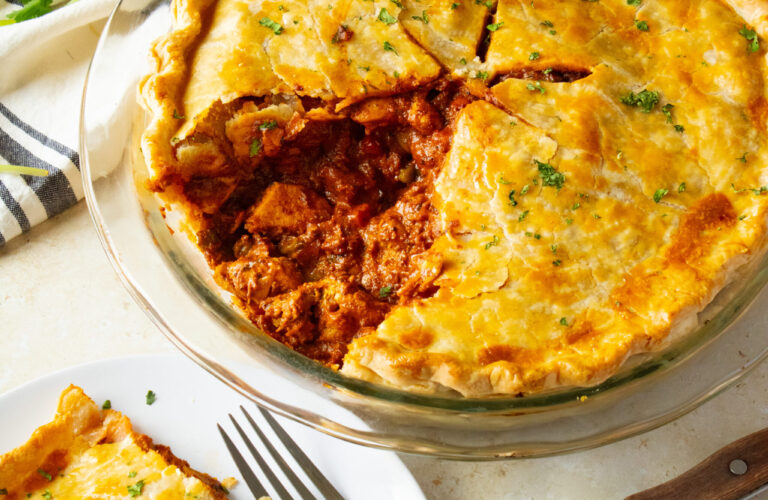
This chicken pie skips the traditional double-crust, bottom-dough approach entirely. Instead, it uses a single top layer of puff pastry, cut into small squares and arranged in an overlapping shingle pattern over a rich, creamy chicken and vegetable filling. Because there’s no bottom crust trapping moisture, steam escapes freely through the gaps between the pastry squares — which means no soggy bottom and no soft, deflated crust. What you get instead is a shatteringly crisp, golden pastry top sitting over a thick, velvety chicken gravy loaded with tender vegetables.
It’s built around a cast-iron skillet, which does double duty — you sear and build the filling right in it, then slide the whole thing into the oven once the pastry is arranged on top. One pan, one pie, minimal cleanup.
This recipe makes one large 10-inch skillet pie, yielding 4 to 6 main-course portions. This guide walks through how to organize your prep, how each ingredient functions, the two filling styles you can choose between, and the full workflow from raw ingredients to a finished, bubbling skillet pie.
Mise en Place: Organizing Your Components
This recipe has three distinct components that come together in stages: the protein and vegetable filling, the roux-based cream gravy, and the pastry crust. Prepping each one separately before you start cooking keeps the process smooth and prevents you from scrambling once things are already in the pan.
The Protein Core:
- 500 grams boneless chicken thighs or chicken breast, cut into 1.5-centimeter cubes
- 3 tablespoons unsalted butter (1 tbsp for searing, 2 tbsp for the roux)
- 1 tablespoon extra virgin olive oil
- 1/4 cup all-purpose flour
- 2 cups chicken broth
- 1/2 cup heavy whipping cream or full-fat whole milk, kept at room temperature
The Vegetable and Aromatic Base:
- 1 medium yellow onion, cut into 5-millimeter dice
- 4 cloves fresh garlic, minced
- 1/2 cup fresh carrots, cut into 5-millimeter cubes
- 1/2 cup fresh celery stalks, cut into thin crescent slices
- 1/2 cup frozen sweet green peas, thawed and dried
- 1 teaspoon fine sea salt
- 1/2 teaspoon cracked black pepper
- 1/2 teaspoon sweet smoked paprika
- 1 teaspoon fresh thyme leaves or dried wild oregano
The Pastry Crust:
- 1 sheet premium puff pastry, kept chilled until use
- 1 large egg yolk whisked with 1 tablespoon water (egg wash)
- 1/4 teaspoon sea salt flakes
Optional Add-Ins (if using):
- 1/2 cup fresh button mushrooms, sliced thin and dry-seared
- 1/4 cup sharp Cheddar or Gruyère cheese, grated fine
- 1/2 teaspoon ground nutmeg
- 1 tablespoon fresh Italian flat-leaf parsley, chopped
- 1/4 cup leeks, sliced into thin rings (as an onion substitute)
- 50 grams smoked turkey bacon, crisped separately
- 1 teaspoon Dijon mustard
Equipment:
- Heavy-bottomed 10-inch cast-iron skillet or deep oven-safe baking pan
- Sharp chef’s knife and cutting board
- Balloon whisk and wooden spoon
- Pastry brush
- Box grater (if using optional cheese)
- Liquid measuring cups and measuring spoons
Understanding the Role of Each Ingredient
Knowing what each ingredient is doing makes the process easier to follow — and easier to troubleshoot if something’s off.
In the filling: Chicken thighs or breast form the protein base; cutting them into uniform 1.5-centimeter cubes ensures even cooking. Butter and olive oil together create the fat base for searing — butter for flavor, oil to raise the smoke point so the butter doesn’t burn. Flour is sprinkled over the seared filling to build a roux, which is what thickens the broth into a proper gravy rather than a thin soup. Chicken broth provides the savory liquid base, while the cream adds richness and body. Onion, garlic, carrots, and celery form the aromatic backbone, while thyme adds a warm, herbal note. Peas are stirred in at the end so they stay bright and don’t overcook. Smoked paprika, salt, and pepper round out the seasoning.
In the crust: Puff pastry is the star here, and it should be a butter-based variety rather than one made with shortening or margarine — butter is what gives the layers their light, flaky puff when they hit oven heat. The egg wash (egg yolk plus water) is brushed over the top to create shine and encourage even browning, and a scatter of sea salt flakes on top adds a bit of texture and seasoning contrast to the finished crust.
Choosing and Handling Your Puff Pastry
The success of the crust depends heavily on how the pastry is chosen and handled:
- Use a pure butter puff pastry rather than one made with vegetable shortening or margarine — butter gives a lighter, more flavorful puff.
- Keep the pastry sheet chilled in the refrigerator right up until you’re ready to cut it. If it warms to room temperature, the thin fat layers melt into the flour and the pastry won’t puff or flake properly.
- Don’t substitute shortcrust or standard pie dough — it won’t give you the light, shattering texture this recipe is built around.
- Before cutting, check that the sheet feels smooth, cool, and firm, without dry cracks, gray spots, or sticky patches along the folds.
Two Filling Styles: Strained vs. Traditional
This recipe gives you a choice in how you want the final filling to feel.
Strained (smooth) version: After the gravy has simmered and thickened, pour it through a coarse strainer into a separate bowl, pressing down to extract all the liquid and leaving the cooked vegetable pieces behind. Then recombine the smooth, strained gravy with the chicken and peas. This gives you a refined, ultra-smooth sauce with no vegetable fibers.
Traditional (non-strained) version: Simply skip the straining step and leave all the diced carrots, celery, onion, and thyme in the filling as-is. This gives a more rustic, farmhouse-style texture with more bite and variety in each spoonful.
Neither version changes the ingredient list — it’s purely a texture choice, so pick whichever suits how you want the pie to eat.
Workflow: From Raw Ingredients to Finished Pie
Step 1 — Clean the produce. Rinse the carrots, celery, onion, and thyme sprigs under cool running water to remove any dust or residue. Dry them thoroughly — leftover water on the vegetables will thin out the cream and cause extra steaming once they hit the hot skillet.
Step 2 — Cut everything to size. Cut the chicken into uniform 1.5-centimeter cubes across the muscle fibers, so it cooks evenly. Cut the carrots and celery into neat 5-millimeter cubes/slices. Mince the onion evenly. Lay the chilled puff pastry flat and slice it into uniform 1-inch squares using a sharp knife or pizza cutter — avoid dragging the blade, which can seal the pastry layers together and stop them from rising properly.
Step 3 — Sear the chicken. Heat the olive oil and 1 tablespoon of butter in the cast-iron skillet over medium-high heat. Lay the chicken cubes in a single layer and sear undisturbed for 3 minutes to build a deep golden crust and lock in the juices.
Step 4 — Build the aromatic base. Add the diced onion, carrots, and celery straight into the pan with the chicken. Toss and cook for 5 minutes until the vegetables soften and turn translucent. Add the minced garlic and thyme leaves and stir for 30 seconds, just until fragrant.
Step 5 — Build the roux and gravy. Sprinkle the flour evenly over the chicken and vegetables, stirring for 2 minutes to coat everything and cook off the raw flour taste. Slowly pour in the chicken broth while whisking to avoid lumps, and bring it to a gentle simmer. Reduce the heat to low, stir in the cream, salt, pepper, and smoked paprika, and let it bubble gently for 5 minutes until it thickens into a glossy gravy that coats the back of a spoon.
Step 6 — Finish the filling. Stir in the thawed peas, then turn off the heat and let the skillet rest for 10 minutes so the filling cools slightly before the pastry goes on top. If you’re going for the strained version, this is the point to pass the gravy through a strainer before recombining it with the chicken and peas.
Step 7 — Assemble the pastry top. Preheat the oven to 400°F (200°C) with the rack in the center. Arrange the chilled 1-inch pastry squares over the cooled filling in an overlapping shingle pattern until the surface is fully covered. Brush a thin, even layer of egg wash over the exposed pastry tops, being careful not to let it run down the cut sides — that can glue the layers together and stop them from flaking. Scatter the sea salt flakes over the top.
Step 8 — Bake. Slide the skillet into the preheated oven and bake undisturbed for 25 to 30 minutes, until the pastry is fully puffed and deep golden-brown with bubbling edges.
Step 9 — Rest and serve. Remove the skillet from the oven and let it rest for 5 minutes so the gravy can settle. Scoop generous portions with a deep spoon, making sure each serving gets a mix of crisp pastry and creamy filling. Serve immediately while the pastry is at its crispest.
Serving Suggestions
For a simple, traditional presentation, scoop straight from the skillet onto plates alongside a light side salad.
For a more elevated presentation: lift a circular portion of the pastry shingles with a ring mold or wide spatula and set it over a bed of the hot filling in a shallow bowl. A light scatter of fresh thyme or micro-greens on top, and a thin line of olive oil around the rim of the plate, dresses it up nicely.
Storage and Make-Ahead Notes
Store leftover pie in a sealed, airtight container in the refrigerator, kept between 2°C and 4°C, and eat within 3 days. Reheat leftovers in a 350°F oven for about 10 minutes rather than the microwave, since the microwave will make the pastry soft instead of crisp.
If you want to prep ahead, cook the filling and freeze it separately in an airtight container or freezer bag for up to 2 months. Don’t freeze the pie fully assembled with raw pastry on top — the moisture from the filling will break the pastry down as it thaws. Thaw the filling overnight in the fridge, warm it slightly, and add fresh chilled pastry squares on the day you plan to bake.
Common Mistakes to Avoid
- Adding cold pastry to a still-hot filling. Let the filling cool before topping it, or the pastry’s butter will melt too early and it won’t puff properly in the oven.
- Skipping the roux stage. A thin, watery broth instead of a proper thickened gravy will boil over and leave you with a soggy pastry top.
- Dragging the knife when cutting pastry. This seals the laminated edges together and blocks even rising — use clean, decisive cuts.
- Letting egg wash run down the pastry’s cut sides. This glues the layers together and stops them from flaking apart.
- Baking at too low a temperature. The pastry needs the full 400°F heat to expand its steam layers quickly; a lower temperature just melts the fat into a greasy result instead.
Crispy Chicken Pie
Description: A single-crust chicken pie with a rich, creamy chicken and vegetable filling topped with an overlapping shingle pattern of golden, flaky puff pastry squares — baked and served straight from a cast-iron skillet.
Duration: About 65 minutes total (20 minutes prep, 15 minutes searing/stovetop cooking, 25–30 minutes baking).
Yield: 1 large 10-inch skillet pie, serving 4 to 6.
Ingredients
For the Filling:
- 500 grams boneless chicken thighs or chicken breast, cut into 1.5-centimeter cubes
- 3 tablespoons unsalted butter, divided
- 1 tablespoon extra virgin olive oil
- 1/4 cup all-purpose flour
- 2 cups chicken broth
- 1/2 cup heavy whipping cream or full-fat whole milk, room temperature
- 1 medium yellow onion, diced
- 4 cloves garlic, minced
- 1/2 cup carrots, cut into small cubes
- 1/2 cup celery stalks, thinly sliced
- 1/2 cup frozen green peas, thawed and dried
- 1 teaspoon fine sea salt
- 1/2 teaspoon cracked black pepper
- 1/2 teaspoon sweet smoked paprika
- 1 teaspoon fresh thyme leaves or dried oregano
For the Crust:
- 1 sheet premium puff pastry, chilled
- 1 large egg yolk whisked with 1 tablespoon water
- 1/4 teaspoon sea salt flakes
Optional: button mushrooms, sharp Cheddar or Gruyère, nutmeg, parsley, leeks, smoked turkey bacon, Dijon mustard.
Instructions
- Rinse and thoroughly dry the carrots, celery, onion, and thyme. Cut the chicken into 1.5-centimeter cubes, and the carrots and celery into small, even pieces. Slice the chilled puff pastry into 1-inch squares.
- Heat the olive oil and 1 tablespoon butter in a 10-inch cast-iron skillet over medium-high heat. Sear the chicken in a single layer for 3 minutes without stirring.
- Add the onion, carrots, and celery. Cook for 5 minutes until softened. Stir in the garlic and thyme, cooking for 30 seconds until fragrant.
- Sprinkle the flour over the mixture and stir for 2 minutes. Slowly whisk in the chicken broth, then bring to a gentle simmer.
- Reduce heat to low. Stir in the cream, salt, pepper, and smoked paprika. Simmer for 5 minutes until thickened into a glossy gravy.
- Stir in the peas. Turn off the heat and let the skillet rest for 10 minutes to cool slightly. (Optional: strain the gravy at this point for a smooth version, then recombine with the chicken and peas.)
- Preheat the oven to 400°F (200°C). Arrange the pastry squares over the filling in an overlapping shingle pattern. Brush with egg wash, avoiding the cut sides. Sprinkle with sea salt flakes.
- Bake for 25–30 minutes, until the pastry is golden-brown and puffed.
- Rest for 5 minutes before serving directly from the skillet.
Notes
- Choose a butter-based puff pastry and keep it chilled until the moment you cut it.
- For a smooth, refined filling, strain the gravy before recombining with the chicken. For a rustic texture, skip straining.
- Store leftovers in an airtight container in the fridge for up to 3 days; reheat in a 350°F oven rather than the microwave.
- The cooked filling can be frozen (without pastry) for up to 2 months; thaw overnight before topping with fresh pastry and baking.
Medical Disclaimer: This content is provided for general informational and culinary purposes only and is not intended as medical, dietary, or nutritional advice. Individuals with food allergies, dietary restrictions, or specific health conditions (including but not limited to cardiovascular concerns, gluten sensitivities, or dietary sodium restrictions) should consult a qualified physician, registered dietitian, or other licensed healthcare professional before preparing or consuming this recipe. Ingredient substitutions, portion sizes, and cooking methods should be adjusted according to individual health needs. The information provided does not constitute a guarantee of any specific health outcome, and reliance on this content is at the reader’s own discretion and risk.